Sharpened Blackwing Palomino Pencil, April 25, 2012
Credit: Maggie Osterberg
http://www.flickr.com/photos/mediawench/

CC BY-SA 2.0
I know that the act of disciplining my daughter makes me a better father than otherwise. It makes me a better person--someone willing to act when things need action. In the broad scheme of things, the small theatre of my life may not have the impact of people like Caesar Chavez or Rosa Parks, but action is no less important simply because the response is small or is a longterm commitment, as is parenting. Both the Queen Bee and myself are shaped into better people through our experience of being family together, and not just through my parental duties of disciplining her when she is disobedient. I don't think anything moves me into happiness the way my daughter's laugh does. Her laugh is so contagious that it makes me laugh, even when something isn't funny, and it feels so good that I never want to stop laughing. I never want her to stop laughing.

I prefer the laughing. It makes us both better. Who wouldn't prefer the laughing? But, the disciplining, the hard-nosed parenting, is really important. I don't enjoy it, but I know it makes me a better father and person to be the type of parent who enforces the boundaries and encourages good behavior. As much as don't like it, the Queen Bee dislikes it all the more. It's easy to understand. None of us appreciates being told we're out-of-line, inaccurate, or flat-out wrong. We all like to believe that we're beyond reproach. The difference between kids and adults is that, with someone there to guide and correct them, kids will learn the lesson. It's a marathon, but kids figure it out. Not so much adults.

Adults, yeah. We hate criticism. We construct a world around ourselves where the possibility of being incorrect is so farfetched that anyone who would critique our actions or tells us that we are wrong must be mentally incapacitated in some way. It's not me who has the problem, it's the person crazy enough to think I might have a problem that has the problem.

Like Randy Pausch shares in the video to the right, when people stop caring, they stop trying to make you better. What we telegraph to others, though, is the opposite: if you criticize me, then you don't care. Still, I've found Randy Pausch's statement true for me. When I lose interest or stop caring, I stop giving feedback or critique, but it's usually because Pausch's statement contradicts the social contract.

When criticized or critiqued, my immediate response is to be defensive because such feedback violates the social contract of "don't criticize me and I won't criticize you" and "if you criticize me, then you don't care." I don't think, Wow, this person really loves me. I think, Who are you to question whether or not I am a genius! We don't like being sharpened or shaped. We want to believe that we've reached perfection and now it is our job to sharpen and shape others.

I don't know that I've ever really been mature enough to handle critique other than defensively. I don't know that I've ever seen it as an act of love. And, honestly, I don't know that anyone else is all that different than myself. Sad, I suppose.
Iron Bridge
Credit: William Warby
http://www.flickr.com/photos/wwarby/
CC BY-SA 2.0
The Queen Bee has entered into a phase where she really wants to test the boundaries. What Sebastian the crab said of teenagers applies to my little pre-K student: you give them an inch, they swim all over. Often, if she is well-behaved, we'll watch an episode of Seinfeld before she goes to bed. (Her favorite episode is The Airport.) Before the episode is over, she is asking if we can watch another one when the current episode is finished--trying to get out of going to bed, that one is.

She also doesn't quite believe the rules apply to her. Before I finished the first paragraph of this post, I had to set her in the Angry Chair because she was disobeying me. She walked up to where I am sitting at the kitchen table and knocked over her half-full juice box. I set it up and told her not to knock over the juice box. Of course, her immediate response was to knock over the juice box. Four minutes in the Angry Chair followed by a discussion on why she needs to obey her parents.

Sometimes she lies.

Noticing the bathroom closet is awry I'll ask her, "Did you get into the bathroom closet?" She responds, without trying to hide the hair supplies she confiscated from the closet, "No."

"Who did?" I ask.

"I think maybe it was mommy," She says.

Four minutes in the Angry Chair.

It gets exhausting. I hate constantly correcting her, constantly reinforcing the boundaries, constantly setting her in the Angry Chair. The truth is, sometimes I skip the punishment. I'm too tired. Just put the scissors back in the drawer and don't do anything else that requires parenting! I go through phases where I'm very diligent about reprimanding my daughter and then I go through phases where it's just enough to get her to move on to the next shenanigan.

This is what it means to be a parent, though. I know this. This is how it is going to be for a long time. And, in the future, I'm sure money will be involved: paying for broken windows, dented cars...paying off bookies (who knows what type of mischief this child will get into when she's older). I love her too much to let her be disrespectful, to let her lie, to let her break the rules. My hope is that all of this shapes her into a beautiful, loving woman who blesses creation with her life.

That's not to say there isn't a lot of joy in my life--the Queen Bee is a hoot! But there is a lot of weariness in parenting, in guiding someone forward in life. It's a marathon I know we will both win in the end. No matter how much she hates it now. No matter how weary I become.


It's been a while since I sat down for a blog post, but all the attention football receives during the NFL playoffs has irked one of my pet peeves just enough to bring me back from blogging exile (at least for a single post). In the last decade, the notion of the "elite" quarterback has inundated the vernacular of football commentators and sports broadcasters. I could be wrong, but I don't remember the notion of "elite" quarterback being discussed when I was growing up, and there were some truly gifted quarterbacks during my childhood: Joe Montana, Dan Marino, John Elway (who I think is the all-time greatest QB--there, Jake, I admit it!), Warren Moon, Steve Young, Troy Aikman, and Jim Kelly are all hall of famers and quarterbacks I grew up watching. But, I never remember ever hearing discussions about their elite level or the comparative lack of eliteness from quarterbacks such as Bernie Kosar, Randall Cunningham, or Jim McMahon. Not so today.

Credit: Saquan Stimpson

CC BY-SA 2.0
Eli Manning was famously asked prior to the 2011 football season if he considered himself in the same class as Peyton Manning and Tom Brady, to which he responded that he did think he was in their class. Everyone scoffed. But, he won the Super Bowl at the end of the season--his second--and everyone's perspective changed. Everyone pretended as if they had never questioned Eli's quarterbacking skills. At the beginning of the 2012 football season, Joe Flacco was asked if he considered himself elite quarterback, and of course he responded in the affirmative. Everyone scoffed. But, Flacco played in his second consecutive AFC championship yesterday (his third overall) and is Super Bowl-bound, and  he has never experienced a season in which he failed to quarterback his team to the playoffs.

Here's my complaint with the way sports broadcasters's discuss elite: they seem to think it is a category one can reach by simply trying hard enough, possessing the right tools, tightening up his game, minimizing mistakes. Elite, though, is not a statistical category, it is a comparative category. For example, I don't think Joe Flacco is one of the elite quarterbacks in the NFL, but compared to the quarterbacks on his team, he is elite. In his division (i.e., AFC North), Ben Roethlisburger is an elite quarterback, but within his conference--indeed, within the NFL--he is a second tier quarterback.

"Elite" is not a concept that stands on its own, like completion percentage or number of interceptions thrown. It exists when comparing one QB with another QB (no one seems to care if your center or linebacker are elite, by the way). You don't "move into the elite class of quarterbacks" (as the CBS pregame crew seem to think) by improving your game, nor do you move into that class by beating so-called "elite" quarterbacks in a head-to-head matchup! Heck, Tony Romo might win the Super Bowl in 2014 and 2015, but that doesn't move him into the same class as Tom Brady or, historically speaking, Jim Plunkett.

By definition, the elite category is the smallest (or nearly so) grouping of quarterbacks. Not every NFL quarterback can be elite, only a few. You can't draft an elite quarterback, it takes years of work to move into the top class of players. So here's how I'd categorize the quarterbacks currently playing in the NFL.
  1. Tier Elite: Tom Brady, Peyton Manning
  2. Tier Honorable: Eli Manning, Ben Roethlisburger, Drew Brees, Aaron Rogers
  3. Tier Commendable: Matt Ryan, Joe Flacco, Matt Schaub, Jay Cutler, Andrew Luck, Robert Griffith III, Russell Wilson, Andy Dalton, Colin Kaepernick, Alex Smith
  4. Tier Fledgling: Philip Rivers, Tony Romo, Christian Ponder, Ryan Tannehill, Sam Bradford, Brandon Weedon, Michael Vick, Mark Sanchez, Josh Freeman
  5. Tier Give It Up Already: Jake Locker, Joe Webb, Brady Quinn, Blaine Gabbert, Matt Cassell, Anyone who plays QB for the Arizona Cardinals
I feel like I could move one or two second tier guys into the top tier, and one or two third tier guys down to the fourth tier (and vice versa), but I feel like this list is a good representation of most of the quarterbacks currently playing in the NFL. (If Joe Flacco--or Colin Kaepernick--wins the Super Bowl, I'll consider him a second tier man, "Honorable." I know that it has become fashionable as of late to criticize Peyton Manning, which I don't mind because I was sickened by all the fawning he received earlier in his career. Still, I think his record as a whole places him in the top tier even though I can understand how one might be offended that Brady isn't in a class of his own. Theses are tiers, though, not rankings of individual players.)

Rest And Be Thankful
Credit: Steve Feather
http://www.flickr.com/photos/7317295@N04/
CC BY-SA 2.0
This morning, I woke up a little after seven because I forgot to turn off my alarm clock for the weekend. If I remember turn off my alarm clock, it usually means that I sleep until a little after 7:30--about the latest the Queen Bee can stay in her bed (she's an early worm). I forgot to buy coffee. Last night, I even made a trip to Wal-Mart to buy coffee but forgot that by the time I got there. I bought a few other things and completely forgot about the coffee. So, I made a trip to the McDonalds's drive-thru window for a large coffee and, since I was already there, I picked up some breakfast. I thought, Man, it is so nice and relaxing to just drive to McDonalds and have my breakfast and coffee prepared for me.

As I thought this I was paying for my meal (first window, please) and I wondered how long the woman accepting my payment had been awake. At what time did she have to be at work? On a Saturday. How long will she work today? Then, as I picked up my order (second window), I started to feel a little guilty because it occurred to me that rest is a benefit of the privileged.

In Vienna, a culture that has not embraced the consumer economy to the same extent as the United States, many shops and businesses remain closed on the weekend (this is especially so on Sunday). I have vague memories of the last remnants of this practice from my childhood in our own country, but I don't think it happens too much anymore. There are too many opportunities to make money, and some businesses are just trying to keep there heads above water, I know. (I suspect that McDonalds would be fine if it were closed on the weekends.)

Rest. Time with family. Relaxation. Vacation. Holiday. Time to read a book or enjoy a football game. These things haven't really concerned me except for when they impact my own life. I haven't really cared much that other people get to enjoy rest. I want businesses open on the weekend because of the convenience it is to me. It's restful for me when I can easily access goods and services on any day of the week at any time. I just haven't thought too much about the cost of that convenience. What a great gift it is to offer rest to someone.

I'm thinking I'm going to try and arrange my life so that, at least on Sundays, I am not participating in the consumption practices so prevalent every other day of my life. And, as I write that, I realize that that'd be rest for me too. Hopefully, it will also be a step towards rest for someone else.

Abel and Melchizedek
Credit: Holly Hayes
http://www.flickr.com/photos/sacred_destinations/
CC BY-SA 2.0
If you identify as a Christian, as I do, then the Bible tends to be an important part of life. I wish that I could admit to reading the Bible a lot, but rather I must admit that these days my interaction with Faulkner tends to be greater than my interaction with the Bible. (I also wish I could admit to feeling badly about this.) Nonetheless, I am somewhat familiar with the Bible and still occasionally find the time and inclination to read it. One of the real struggles for Christians is to think that God can--and does--work not just within the narrative of our own lives, but outside it, too. I was confronted with this reality a few days ago while reading Genesis.

As a Christian, I've adopted the story of the Bible as my own story. The exodus from Egyptian bondage, the reign of David, the divided kingdoms of Israel and Judah, the exile in Babylon, the return to the promised land, and of course the life of Jesus: all these stories (and others), I see them as being my own story. The stories collected in the Bible are the history of my people. It is the story of how God has interacted with creation through my people and, often, for my people. But, God has worked on behalf of all of creation and all peoples, not just my people and not just through my narrative. This is the section of scripture that struck me:
14:18 Melchizedek king of Salem brought out bread and wine.(Now he was the priest of the Most High God.) 14:19 He blessed Abram, saying,“Blessed be Abram by the Most High God, Creator of heaven and earth. 14:20 Worthy of praise is the Most High God,who delivered your enemies into your hand.” Abram gave Melchizedek a tenth of everything (Gen. 14:18-20).
It seems to me that just as God is working through Abram/Abraham to bless creation, so he is also working through Melchizedek. In other words, God is working through Abraham, but he's not working solely through Abraham. God wasn't simply selecting one family or one race of people to save at the exclusion of all other families and peoples.The story of the Bible is told from the perspective Abraham and his people, not from the perspective of Melchizedek (the study note in my Bible states that Salem, where Melchizedek was king, was a Jebusite stronghold). Melchizedek, though, emerges in the narrative of Abraham, the narrative of Israel and Christianity, and shows us a man who is faithful to God. Indeed, Melchizedek is called a priest of God.
I think that's an important something to remember. Just because we're (i.e., Christians) aren't in a particular place doesn't mean that God isn't there.


I've been fascinated with mounting climbing since I was a teenager--when I first read Into Thin Air. I suppose I could trace my fascination with mountain climbing back to the books by Jack London I read in my even younger days: Call of the Wild and White Fang. Or, to draw this out as long as possible, maybe it was growing up in western Oklahoma, a land epitomizing the geometric plane. Oklahoma, a land where the 2400 foot Mount Scott makes "mount" a dubious distinction.

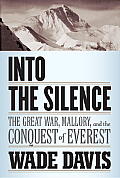
The first time I became aware of Into the Silence by Wade Davis, I was immediately interested in the book because, not only do mountains (real, actual mountains) mythically possesses my imagination, but one of my favorite periods of history to study is World War I. Davis explores the impact of the first world war upon European society and, as well, how the war shaped the men who attempted to climb Mount Everest in the wars immediate aftermath (the expeditions involving George Mallory in 1921, 1922, and 1924).
Mount Scott
Credit: Declan McAleese
http://www.flickr.com/photos/djmcaleese/
Mount Scott towering over western Oklahoma.

Into the Silence was meticulously researched (seems like one review on the back cover stated that Davis spent 10 years researching the book) and this is apparent by the book's depth and richness. No character is simply introduced, we are provided his or her (usually his) complete background including, but not limited to, grammar school records, past lovers, and of course his role in the war. At times, this is too much as bit-players in the Everest expeditions are given treatments equal to that of George Mallory or Charles Howard-Bury and the reader is left feeling as if Davis is more concerned that everyone know how well he researched the project rather than just telling the story. But, this is a minor nuisance rather than a tremendous distraction. While the details are much and facts ever-present, Davis does not forget the story and we gain great incite into the mountain-conquering motivation of these war-survivors.

The war details are often graphic and unsettling, but they nonetheless draw us into greater understanding of how the war happened, why it lasted so long, and what war actually is (his account of the Battle of Loos is particularly harrowing). This is one of my favorite quotations describing a pre-WWI British attack upon the Tibetans:
‎"...[T]he British pushed on, fighting a series of skirmishes that climaxed in a two-month siege at Gyantse, where they endured tens of casualties while inflicting on the Tibetans some five thousand. With such a ratio of suffering, it is not surprising that the British generals had come by 1914 to view war as something glorious."
Into the Silence is a long book; you won't read it in a week (unless that's all you have to do), but it is a book well-worth reading. As far as I know, there is no other published book like it. It provides the facts, it tells the story, but these are not allowed to simply exist in a moral vacuum of ambiguity. Both facts and story are held accountable and, thus, Into the Silence presents the reader not only with a good adventure story and a thorough history, but a troubling moral dilemma upon which readers will continue to ponder long after the book is closed and shelved.
A couple of years ago, the Queen Bee started attending a day school for five hours a day, two days a week. After a few months, she began attending the day school three days a week and this has been our norm until the beginning of this month when my marvelous little girl entered the world of public education. I think it was a much bigger step for Gretchen and I than it was for the Queen Bee. Her first day, I dropped her off and I could tell she was unsure and shy, but by no means was she intimidated. Some days, she doesn't even want me to walk her through the doorway of the school. Other days, she clings to my leg so I won't leave (I think this is mainly mimicking the behavior of other kids she sees around her because her's is usually a pretty weak effort).

In the past, when she attended the day school, Gretchen always made the Queen Bee's lunch and we sent her off with this snazzy Beatles lunchbox. Everyday for the last couple of years, if the Queen Bee has gone to school, she's gone with her Beatles lunchbox. Oh, and if you don't know why a Beatles lunchbox is awesome....

Well, with the beginning of Pre-K, I started making the Queen Bee's lunches. This wasn't an official changing of the guard; I just started making the lunch and had a lot of fun doing it. I enjoyed the challenge of finding her new things to put in her lunchbox so that she didn't get bored with her food. Nonetheless, most days the lunchbox was returned to my care with hardly any of the food being eaten. We reached the conclusion that, being the only kid in her class to bring a lunch to school, she really wanted be like the other kids and eat a cafeteria lunch. So, last Tuesday, I went to her school and paid for a month's worth of cafeteria lunches.

I'm a bit brokenhearted to send the Beatles lunchbox into retirement so early in the Queen Bee's education experience, and I really do miss that little jolt of joy I received from making her lunches. However, the Queen Bee loves eating the cafeteria food with her friends at school. The first day she told me about how she drank a little carton of milk with ice slivers in it, how she carried her tray to her table and, when she was done eating, how she raised her hand and the teacher removed her tray from the table and dumped the trash in the trash can (all of this was mimed with exquisite execution).
I know I've said it before: I try not to be a parent who is constantly awestruck by how quickly my child is growing up. I don't want to miss the beauty of the Queen Bee's current stage of life because I was wasting time reminiscing or lamenting the past. I don't lament the past. I celebrate my daughter's growth and development. I do feel a slight sense of betrayal that my time as lunchmaker was taken from me so quickly, though. I will spend a little bit of time--at least one blog post--lamenting the passing of this stage. But, maybe Gretchen will starting taking the Beatles lunchbox with her to work? Who knows?
Scene--Backyard under the canopy of three large pecan trees; Gypsy-father is hanging laundry on the line as the Queen Bee wanders about.

Queen Bee: [picks up a stick, fallen from a pecan tree, off of the ground; it is approximately a yard in length]    
                   Daddy, I found that new stick that I gave you yesterday.

Gypsy-father: Yes, I remember that stick. I used it to move the charcoal in the grill yesterday evening.

Queen Bee: I am going to use it now. I will find you another stick to use.

Gypsy-father: OK--

Queen Bee: [interrupts Gypsy-father] Because you're too old to use this one.

Gypsy-father: What?!?

Queen Bee: You're really old.


If you happen across here and things are a mess, it's because I'm working on some changes to my blog.
Tuchlauben 4
http://www.flickr.com/photos/dugspr
CC BY-SA 2.0
The yellow building on the left houses 
Eissalon Tuchlauben.
It seems that I miss Vienna the most once the high, oppressive temperatures of the Oklahoma summer emerge. There have been a couple of hot days here and there already this year, but this week the prediction from the weather fortune tellers is that everyday will hit 89 or 90 degrees. (That's something like 32 degrees for you Europeans out there...actually, for anyone anywhere in the world other than the United States.) Vienna is the perfect climate for someone of my composition: plenty of cool, snowy weather in the winter; marvelously long fall and spring seasons; a summer that makes it warm enough to swim in the afternoon and cool enough to enjoy kaffee in the evening. Well, as I sit here longing for some Vienna weather, I thought I'd break out an old staple (not really, but...) of my blog: the MY:WIEN series.

In Vienna, most of the Eissalons open only during the summer months, and that is the case for Eissalon Tuchlauben. Gretchen had a friend, who started out as a penpal while we were living in the States, who recommended this Eissalon. We liked it because of its location in the city center, yet still it is nestled back on a narrow street so it kind of secluded. It became a really special place for us. In fact, we did feel like it was our Eissalon and we never took any of our American friends there. We never went there with Austrian friends, for that matter. We sometimes called it our secret Eissalon. I don't think we made any real effort to hide it; I know that initially we told people about this Eissalon with the really good Eis, but no one seemed all that interested. We liked that it turned out that way. It was our place. It belonged to us.

Photo from Eissalon Tuchlauben's website.
http://eissalon-tuchlauben.at/der-eissalon/uber-uns/der-eissalon
We weren't regular patrons at Eissalon Tuchlauben, though. We normally went there after we accomplished a task that was, in our minds, complicated, or to celebrate. After we turned in our applications for visas--a high-stress task--we probably headed over to our secret Eissalon for a victory Eis (not to be confused with Victory Gin). Then, when we were actually granted visas, we'd head back for another victory Eis. I think our first victory Eis may have been after we opened our bank account in Vienna, but I can't remember.

Interestingly enough, in the late summer of 2009, we were out with some teammates and friends walking about the city center when someone suggested ice cream. Our teammates suggested this place to which they had recently been introduced, Eissalon Tuchlauben! Gretchen and I didn't immediately put it together  that this was our secret Eissalon; we were being led to it in a very roundabout fashion, plus we so rarely called it by its actual name that it simply didn't register in our minds. But, sure enough, we ended up at Eissalon Tuchlauben. We never mentioned that this Eissalon was, in fact, was our secret Eissalon. It seemed a little less special after that, however I'm sure the next time we get to visit Vienna we'll be over that!

Besides, after this post, Eissalon Tuchlauben will be known and discussed by my thousands of readers.


View Larger Map

The best way to get to Eissalon Tuchlauben is to take the U1 (red line) Ubahn to Stephansplatz and then walk to Tuchlauben 15 as highlighted in the map above.

boat ride
A small lake in Ethiopia. We went out on
a row boat with questionable seaworthiness.
This is the last of my post inspired by Memorial Day weekend. I meant to post this yesterday, but I didn't get a chance to finish writing it.

At church last Sunday, after the singing of a few patriotic songs, the sermon--with the assistance of power point--highlighted some of the major conflicts of the United States giving specific focus to the number of American soldiers lost in each conflict. This was done so that the laity might be convicted of freedom's steep price and, naturally, it was noted that these sacrifices pale in comparison to the ultimate sacrifice of our lord and savior upon the cross, which gives spiritual freedom. (I can't remember exactly how the clergyman articulated it, but there was some kind of inference at play throughout the sermon that the only reason the U.S. goes to war is to preserve our religious freedom.)

He insinuated that there would be no Christians in the U.S. but for the freedom of religion granted by the state, and I resented that, but the truth is he's probably right. My faith is pretty fickle and if my life was on the line, if there were no freedom of religion in this country, I'm sure I could give it up without much fuss. (Heck, given all the baggage I have from church, it might even be a relief to not have it!)

He insinuated that the U.S. is a nation chosen by God to bring about His will. I've lived in Austria. I have friends there. I prefer the Austrian way of life to the American. My daughter is Ethiopian. Ethiopia has many thousands (millions?) of Christians there. (Austria does too, but they're Catholic and most Americans seem to think a Catholic Christian is only as good as one-quarter an evangelical Christian, but Imma let that dog rest for now.) I just can't feel comfortable with that sentiment, that idea that the U.S. is blessed by God and others are not. I wonder how the Native Americans feel about that type of stuff. What about the Philippines or Okinowa? You can't deny that the U.S. is wealthy and advanced and industrialized and yada yada yada. I just don't know that it's wise to assign the reason for all this to God. Especially when, like I said, there are a lot of Christians in Ethiopia, in Mexico, in Brazil. And, let's face it, the means by which the U.S. has attained it's land and wealth isn't, by any stretch of the imagination, godly.

I'll just go ahead and say it--no one reads this stuff anyway--I do think it is idolatry to sing patriotic songs, to display the American flag (or any nation's flag), to cite the Pledge of Allegience, and so on in our worship service. I do think it's wrong to pray that our soldiers will be successful in killing people the empire has deemed as a threat. Rather, we should pray for our enemies and long for them to be brothers and sisters in righteousness.

But I also know I am a rich beneficary of this nation and its policies.


DSCF0458
The view from our Vienna apartment looking
towards UNO City.
While in high school, my family moved to a different town and joined a church that periodically used the worship service to propagate American patriotism, usually around patriotic holidays, by singing patriotic anthems, such as "The Battle Hymn of the Republic," and by reciting the Pledge of Allegiance, and praying for the troops. Prior to joining this church, I was never much exposed to such a display in a worship service (other than praying for the troops) and it took me a while to get used to it. I didn't think it was wrong, just different than what I was accustomed to. Then, in college/early adulthood, I was a member of a church that made grand sweeping gestures of patriotism and nationalism. It was commonplace in Bible classes and worship services to endorse the American agenda, especially the Republican perspective of the American agenda. As I married and settled into the routine of life, all of this seemed normal. It seemed right; it seemed good.


Then, for a short while, I was a part of a church planting team in Vienna. We were working to help people see how the little story of their lives connected to the big story of God the creator and His interaction with creation. I didn't last very long in Vienna, but it was long enough to make a significant impact.
Upon returning to the United States, I was quickly overcome with the "us versus them" rhetoric of 24-hour news channels and the American exceptionalism espoused in churches. I don't know that it was more prominent than when I had departed for Vienna (roughly two and a half years earlier), but my perspective was different and my perspective was insulted by what I was seeing.


DSCF0227
View of Vienna from Leopoldsberg. Many believers
in this city would perish in the event of war.
This is has happened many times in the past.
I realized that, in the church, people identify more strongly with empire than with kingdom. I realized that people were more strongly unified around the flag than the cross. I realized that most American Christians, should their nation call upon them to do so, would raise up arms and wage war against Austrian Christians. Because American Christians identify more strongly with the flag than the cross, it seems right to wage war against other Christians if the empire says to do so. As I wrote yesterday, it seems good, in America, to have enemies and to wage war against enemies. But I could never do it. I could never engage in the practice of war, I don't think, because I don't want to raise arms against my brothers and sisters of the kingdom. I don't want to raise up arms against my enemies--I don't want enemies. I can't pray for our troops to be successful in killing. I can't pray that our enemies will suffer. I can only long for God to make things right. I don't want enemies.


"What is the biggest threat to America?"

This now seems to be a normal, regular question asked of a person running for office in the United States, but I don't think that it is asked in order to determine a candidate's grasp of American foreign policy or America's role in the international system. I think, rather, it is a question asked so that a candidate may opine significant on the goodness and greatness of the United States. It is a question asked so that the candidate's relative love and commitment to the U.S. may be judged or ascertained. If the answer is unsatisfactory, then the candidate's patriotism is thus unsatisfactory or at least suspect, and his or her political opponents will use the unsatisfactory answer to their own advantage.

I started thinking about this a little after reading this article at Huffington Post in which Colin Powell responds to Mitt Romney's statement that Russia is the greatest geopolitical foe facing the United States. In Powell's estimation--and in my own estimation, for that matter--Romney is way off in his assessment. In this day and age, what with Osama bin Laden dead, naming the enemy can be tricky, but we have to have one. That's nonnegotiable (as is waging war against the enemy). I remember quite clearly when President George W. Bush named Iraq, Iran, and North Korea as the components of an axis of evil. Of course, during the Cold War the enemy was never in question; no need to ask "What/who is America's greatest threat?"

I can't help but wonder, must we have a greatest threat? Must we have an enemy? Can a candidate express patriotic sentiment apart from his or her unwavering hate of the enemy? Is our country so divided on domestic policy that the only thing around which we can unify and upon which we can agree is that the enemy must die?

If we must have a threat, if it is impossible to have a life without the "greatest threat," then who is really our greatest threat? If an enemy is a necessary component of our self-understanding, then who is really our greatest threat? Is it not ourselves? Are we not, then, our own biggest threat?

On a side note, this post may contain the most questions of any post I've written to date.


Coins
Credit: glennharper
http://www.flickr.com/photos/glennharper/
CC BY-SA 2.0
Almost a year ago, a man waded into San Francisco Bay at a neck-high depth. Then, slowly, he inched farther out into the water. Apparently, the man was suicidal. He remained in the water for roughly 60 minutes, and a crowd of people watched. A crowd of first responders watched. After an hour, someone pulled the man's lifeless body from the water.

I'm not sure why I saved this story. Maybe because it's so bizarre. 

According the fire chief, the first responders wanted to save the man but due to budget cuts they were without the appropriate training and equipment to do so. In the news story, the fire chief is quoted as saying, "They're standing there wanting to do something, but they are handcuffed by policy at that point."

After public outrage over the incident, the city was able to find funds to train and certify 16 firefighters for this type of scenario.

It was a dangerous situation, I believe, and I don't fault anyone present for what happened. It was an instant in which a number of unfortunate things converged: the water was too shallow for the Coast Guard boat, the Coast Guard helicopter needed to refuel, the firefighters were ill-equipped and ill-trained, the pitiful decisions of policymakers.

I think maybe I saved this story because it clearly demonstrates how money and life are intertwined. In legislatives bodies, whether the UN, US congress, or local city councils, money is separated from the lives it impacts. Men and women in these positions of power can cut funding for AIDS victims, SNAP recipients, Medicare, or firefighters and never have to face the impact of those decisions. The policymakers don't have to look into the eyes of the suffering and say, "It's not my responsibility." They say it from within the climate-controlled halls of legislation. They say it to cameras, not faces.

Not here. Not this time. The impact of local fiscal policy is obvious. It's not any different for the higher levels of government, it's just easier to ignore. It's easier to be isolated from the effects of policy. After all, how many of us really know if someone lives or dies in Africa or Haiti?

It's just Monopoly money and they're all Monopoly pieces. We're all Monopoly pieces.

This, incidentally, illustrates what I wrote yesterday: modes of church giving that are currently practiced originated in the empire, not the kingdom. Think about it.